Powered By Blogger

Thursday, 23 August 2012

" THE MUDRAS " MEDITATIONS WITH FINGERS AND HANDS , THE ANCIENT TAMIL MEDICINE

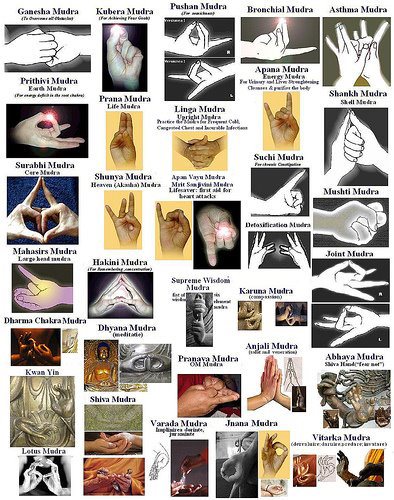
Mudras Traditional Tamil medicine emphasizes that as the proportion of the basic elements that have the body (earth, water, air, fire and ether) will be healthy and balanced or unbalanced getting to be 
even seriously sick. Just as each element can have a positive influence on us, you can also destroy us. This can restore inner balance through the language of gestures. The following meditations can be done for a few minutes a day and its effectiveness is assured. Require our full attention and fingers of our hands. These gestures called Mudras. These gestures are very important because they allow us to properly channel the energy through our body and to facilitate the achievement of many goals as the spiritual upliftment, healing physical and emotional healing. Meditation 1: With the power of the thumb. The element fire, the lung meridian, and Mars (the planet and ancient god of war) are associated with the thumb. The fire feeds the energy of the thumb of the other fingers and absorbs excess energy. Thus, restores the balance. It is similar to the destructive power of fire or fever. Exercise Lying or sitting around your right thumb and four fingers of his left hand and place your left thumb along the inside edge of the right hand. Close your eyes yconcéntrate in the breath that flows within. Now imagine a white light that lights you up completely, and through you down to your roots and then up to your head lit up your world. Each time you exhale, send light rays directly to the diseased body part. Focus on the body part that is weaker or sick. Calmly repeat. Focusing only on white light illuminates and purifies you, make silence within. You will notice as they come out large and dense dark energy-like clouds of smoke, fleeing a body and an enlightened mind and peace. This exercise is also recommended in situations of stress. Meditation 2: With the power of the index finger. The throat chakra, the large intestine and the stomach meridian is associated with this finger. In this finger is also attributed the ability to command, reflection, inspiration and intuition. It also relates to the air element, which represents the mind and the power of thought. The planetary energy associated with this finger is Jupiter, which indicates the eternal change of things, accept life with all its facets. Exercise Lying or sitting around your index finger and four fingers of his left hand, leaving the thumb is extended to half of his right hand. Close your eyes. You focus on your breathing and feel the movement of the universe to the rhythm of your inhalations and exhalations your. Now look at your thoughts come and go. Obsrervalos carefully for a while. Do you listen to your inner dialogue? Do you know that our unconscious thoughts greatly weaken us? What are your thoughts, positive or negative, conscious or unconscious? If we make the following meditation for several days, we realize that there is a certain habit in our thoughts. Habits can be changed by the time we become aware of them, but changes always require a certain amount of time and effort. If we strive to continuously replace harmful thoughts by conscious thought and useful, we can change the circumstances of our lives accordingly. Keep your finger in this situation for a while and feel the heat flows. Meditation 3: With the power of the middle finger. It relates to the heart chakra. With this finger, which is the longest of all, our body tells us and the heart can reach heights that we can not achieve with other parts of our body. Radiates its energy at infinity. Could also be considered how a stairway to heaven. The planet that fits your energy is Saturn, situated on the edge of our solar system and also called the "guardian of the threshold." But Saturn reminds us that progress in our spiritual journey, we must first meet our chores around the Earth. The meridians involved in the energy of this finger are the meridian circulation and the meridian of the gallbladder. Both help us seize and master the challenges of life. Exercise Lying or sitting around your right middle finger with the four fingers of your left hand. The left thumb should extend to the middle of his right hand. Close your eyes. Imagine yourself in your work. You're doing what you love to do. There you can make full use of your talents and inclinations to overcome all obstacles that appear in your way. Visualize yourself succeeding. Visualize yourself being happy doing what you do. Think that your actions enrich the world. The divinity is expressed through you and your actions when you forget to do that for you and what you're meant to do. If your occupation does not satisfy you and if you have no leisure activities or interests that you indulge, then it is time to ask within, until you receive an answer and accept it. Hold your finger in silence for a while and feel the heat flowing in you. Repeat with your left middle finger and changes hands. These hand positions also have an excellent effect on tension in the neck. Meditation 4: With the power of the ring finger ring finger is associated with Apollo, the sun god, and the root chakra, which governs the pelvis. It is the force of resistance. The Chinese have linked finger with the liver meridian. The power of the liver gives a person patience, serenity, hope and vision for the future. Exercise Lying or sitting around your left ring finger and four fingers of his right hand, thumb extended right into the middle of the left hand. Close your eyes. Imagine the earth, the mountains and rocks crushed in all its forms whether in the deserts, mountains or islands. What happens when the masses of earth begin to move? And when the earth is dry? And when the earth is fully exposed to the sun? Now imagine the fertile land. Slowly let the vegetation appears. Buds, stems, leaves, seedlings, shrubs, trees, forests. Now visualize a seed. With every breath we make, something moves inside the seed gradually grows and expands into the light. . At the same time, we see it take root deep in the earth. It becomes a tree that grows slowly. You see it grow slowly because we know that time is not important. Has only continued growth. The tree blooms anew every year, and bears fruit. Like the tree-giving and each year pays off, we can also succeed if we give fully to life and act according to his purpose. Keep your finger for a while and feel the heat flowing. Then do the same with your other hand. Meditation 5: With the power of the little finger Linked to the second chakra, the energy center of sexuality. Also associated with this finger with the ability to communicate. Also related to the water element (water symbolizes the realm of emotions). Relationships, nourish and strengthen or weaken. And, in turn, give us the ability to be happy. They give us sublime feelings and improves our mood. According to our relations have clear or dark water. We will have independence or dependence. We experience the relationships act as a reflection of those qualities of our shadow which we reject or refuse to recognize. Venus is the planet involved. Exercise Lying or sitting around your left little finger with the four fingers of his right hand, until your right thumb extending to the middle of your left hand. Close your eyes. With the eye of your mind scroll to the seashore and watch the waves that you get wet feet. The same image can be applied to your feelings. Emotions work like waves that flow subject to the law of giving and receiving. Emotions can also be described as clouds do not allow us to have conscious thought. So you see yourself in the midst of a wave or a storm. We focus on breathing, calm down. Aspire and exhale visualizing white light. We focus on monitoring our thoughts and feelings. The white light comes faintly. Gradually we see the tide go away and clouds. Sunlight appears. The calm, love and peace will settle back into our hearts and in the spring now conscious thoughts and deep harmony. Continue the same operation on the other hand. Surround your right little finger and hold it by the same amount of time.

Wednesday, 22 August 2012

Tuesday, 21 August 2012

HINDU WAY OF LIFE

WHAT IS THE HINDUS WAY OF LIFE.

For many Hindus there are four goals in human life (purusharthas);

1 Moksha - the release of the soul (Atman) from the cycle of rebirth.
The individual soul (Atman) unites with Brahman the universal soul. T
here are different ways to Moksha.
spiritual - involves acquiring spiritual knowledge through yoga and meditation. devotion to god
working selflessly for the good of society.
How a person is reincarnated is determined by karma.

2 Dharma - the code for leading one's life.
Respect for elders is considered important and many consider marriage as a son's religious duty.
3 Artha - the pursuit of material gain by lawful means.

4 Karma- through pure acts, knowledge and devotion, you can reincarnate to a higher level. The opposite achieves the contrary result.

Great Reflexology Chart for Hand Points

Great Reflexology Chart for Hand Points..

Hindu Astronomy

Count Bjornstjerna proves conclusively that Hindu astronomy was far advanced even at the beginning of the Kaliyug or Iron Age of the Hindus, about 5000 years ago.

They knew about the precession of the equinoxes anti about the diurnal revolution of the earth on its axis which the priests (Brahmins) discussed in the 5th century B.C.

The above quotations give some idea of the antiquity of the astronomical science of the ancient Hindus. There are numerous treatises written by famous scientists on astronomy and also astrology which was considered equally important. Some of the well known scientists were Parashar (12th century B. C.), Aryabhata and Varahamihira.

“The Hindu astronomers knew about and practiced .the division of the ecliptic into lunar mansions, the precession of the equinox, the earth’s self support in space the revolution of the moon on her axis, her distance from the earth, the dimensions of the orbits of the planet and the calculation of the eclipses.

The ancients knew about the roundness of the earth. In Aryabhateeya we read: ‘The earth, situated in the middle of the heaven and composed of five elements, is spherical in shape.

The theory of gravity is thus described in the Siddhanta Sirornani: ‘The earth, owing to its force of gravity, draws all things towards itself, and so they seem to fall towards the earth.

Another ancient scientist, Gargya, was the first enumerator of constellations and divided the zodiacalbeli into 27 equal parts. Varahamihira, son of Gautania is said to be the first person to identify Jupiter (Brihaspati), reference to which is to be found in the Rig-Veda.

Towards our time, A. D. 1727, we have Maharaja Jai Singh II, the builder of Jaipur, one of the earliest planned cities and of the famous observatories in Jaipur, Delhi, Varanasi, Mathura and Ujjain. A number of the instruments in these observatories are still working accurately. The sun—dial in Jaipur still gives the time with an accuracy of two seconds! Sawai Jai Singh corrected the Indian almanac also.

The Beginnings of Hinduism

The ancient Persians, who occupied the lands west to the Indus River called the whole country lying across the Indus River Sindh and its inhabitants Sindhus, a designation that was later taken over by the Greeks who succeeded them and resulted in the now commonly used designations of India and Indians. The Muslims, who began invading India from the eighth century onward, used the term Hindu as a generic designation for non-Muslim Indians, identical with “idol worshipers.” In the 1830s Englishmen, writing about the religions of India, added -ism to Hindu and coined the term Hinduism, making an abstract and generic entity out of the many diverse and specific traditions of the Hindus.

While Hindus have appropriated the designation Hindu and use it today to identify themselves over against Muslims or Christians, they have expressed reservations with regard to the designation of Hinduism as the “religion of the Hindus.” They see a certain disrespect in the -ism suffix and emphasize that the Hindu dharma is more comprehensive than the Western term religion: it designates an entire cultural tradition rather than only a set of beliefs and rituals. With these reservations in mind, we are going to use the widely introduced term Hinduism in describing the majority religio-cultural tradition of India in spite of the impossibility of defining it in any precise manner. 

The Vedas, the oldest literary monument of the Indian people, a collection of hymns composed in an archaic Sanskrit, are universally considered the foundational scriptures of Hinduism. The authors of these hymns called themselves Āryans, “Noble People.” The date of the composition of these hymns and the original habitat of the Aryans have become one of the most contested issues in Indian studies. The polemical literature has reached such dimensions and the emotions have been raised to such heights that only a sketch of the controversy and some hints about its ideological background can be given in this place.

Around 1860 a group of European Sanskritists suggested that the best explanation for the many common features of what later were called the Indo-European languages was the assumption of an invasion of a band of Aryan warriors, who till then had been living somewhere between Central Asia and Western Europe, into India. Did not the Ṛgveda, the oldest Sanskrit source, describe the battles, which the Āryas, under their leader Indra, the “fortdestroyer,” fought against the Dasyus, whose land they occupied? Making the self-designation ārya (noble) a racial attribute of the putative invaders, every textbook on Indian history began with the “Āryan invasion” of northwestern India, the struggle between the “fair-skinned, blonde, blue-eyed, sharp-nosed Aryans on horse chariots” against the “black-skinned, snub-nosed indigenous Indians.”

This putative “Aryan invasion” was dated ca. 1500 bce, and the composition of the hymns of the Ṛgveda was fixed between 1400 and 1200 bce. The Aryan invasion theory was conceived on pure speculation on the basis of comparative philology, without any archaeological or literary evidence to support it. It was resisted as unfounded by some scholars from the very beginning. In the light of recent archaeological finds, it has become less and less tenable. Nevertheless, the Aryan invasion theory, recently downgraded to an Aryan migration theory, is still widely defended and forms part of many standard histories of Hinduism. In the following, the arguments pro and con will be presented, and it will be left to the reader to judge the merits of the case.

THE ARYAN INVASION THEORY

Eighteenth- and nineteenth-century European attempts to explain the presence of Hindus in India were connected with the commonly held biblical belief that humankind originated from one pair of humans—Adam and Eve, created directly by God in 4005 bce—and that all the people then living on the earth descended from one of the sons of Noah, the only family of humans to survive the Great Flood (dated 2350 bce). The major problem associated with the discovery of new lands seemed to be to connect peoples not mentioned in chapter 10 of Genesis, “The Peopling of the Earth,” with one of the biblical genealogical lists.

With regard to India this problem was addressed by the famous Abbé Dubois (1770–1848), whose long sojourn in India (1792-1823) enabled him to collect a large amount of interesting materials concerning the customs and traditions of the Hindus. His (French) manuscript was bought by the British East India Company and appeared in an English translation under the title Hindu Manners, Customs and Ceremonies in 1897 with a prefatory note by the Right Honorable F. Max Müller. Addressing the origins of the Indian people, Abbé Dubois, loath “to oppose [his] conjectures to [the Indians’] absurd fables,” categorically stated: “It is practically admitted that India was inhabited very soon after the Deluge, which made a desert of the whole world. The fact that it was so close to the plains of Sennaar, where Noah’s descendants remained stationary so long, as well as its good climate and the fertility of the country, soon led to its settlement.” Rejecting other scholars’ opinions that linked the Indians to Egyptian or Arabic origins, he ventured to suggest them “to be descendants not of Shem, as many argue, but of Japhet.” He explains: “According to my theory they reached India from the north, and I should place the first abode of their ancestors in the neighbourhood of the Caucasus.” The reasons he provides to prove his theory are utterly unconvincing—but he goes on to build the rest of his “migration theory” (not yet an Aryan invasion theory) on this shaky foundation.

When the affinity between many European languages and Sanskrit became a commonly accepted notion, scholars almost automatically concluded that the Sanskrit-speaking ancestors of the present-day Indians had to be found somewhere halfway between India and the western borders of Europe— Northern Germany, Scandinavia, southern Russia, the Pamir—from which they invaded the Punjab. When the ruins of Mohenjo Daro and Harappa were discovered in the early twentieth century, it was assumed that these were the cities the Aryan invaders destroyed.

In the absence of reliable evidence, they postulated a time frame for Indian history on the basis of conjectures. Considering the traditional dates for the life of Gautama, the Buddha, as fairly well established in the sixth century bce, supposedly pre-Buddhist Indian records were placed in a sequence that seemed plausible to philologists. Accepting on linguistic grounds the traditional claims that the Ṛgveda was the oldest Indian literary document, Max Müller, a greatly respected authority in Veda studies, allowing a time span of two hundred years each for the formation of every class of Vedic literature and assuming that the Vedic period had come to an end by the time of the Buddha, established the following sequence that was widely accepted:

 * Ṛgveda, ca. 1200 bce * Yajurveda, Sāmaveda, Atharvaveda, ca. 1000 bce * Brāhmaṇas, ca. 800 bce * Āraṇyakas, Upaniṣads, ca. 600 bce

Max Müller himself conceded the purely conjectural nature of the Vedic chronology, and in his last work, The Six Systems of Indian Philosophy, published shortly before his death, admitted: “Whatever may be the date of the Vedic hymns, whether 1500 or 15000 bc, they have their own unique place and stand by themselves in the literature of the world.” 

There were already in Max Müller’s time Western scholars, such as Moriz Winternitz, and Indians, like Bal Gangadhar Tilak, who disagreed with his chronology and postulated a much earlier date for the Ṛgveda. Indian scholars pointed out all along that there was no reference in the Veda to a migration of the Āryas from outside India, that all the geographical features mentioned in the Ṛgveda were those of northwestern India and that there was no archaeological evidence whatsoever for the Aryan invasion theory. On the other side, there were references to constellations in Vedic works whose time frame could be reestablished by commonly accepted astronomical calculations. The dates arrived at, however, 4500 bce for one observation in the Ṛgveda, 3200 bce for a date in the Śatapatha Brāhmaṇa, seemed far too remote to be acceptable, especially if one assumed, as many nineteenth-century scholars did, that the world was only about six thousand years old and that the flood had taken place only 4500 years ago.

Present-day defenders of the Aryan invasion/migration theory are displaying what they believe to be an impenetrable armor of philological detail research: in addition to the Ṛgveda and the Avesta, whole libraries of literary documents pertaining to dozens of languages are marshalled and “laws of scientific linguistics” are adduced to overrun any opposition. The scholarly debate has largely degenerated into an ideological battle. The defenders of the Aryan invasion theory call everyone who is not on their side “fundamentalist Hindu,” “revisionist,” “fascist,” and worse, whereas the defenders of the indigenous origin of the Veda accuse their opponents of entertaining “colonialistmissionary” and “racist-hegemonial” prejudices.

Many contemporary Indian scholars, admittedly motivated not only by academic interests, vehemently reject what they call the “colonial-missionary Aryan invasion theory.” They accuse its originators of superimposing—for a reason—the purpose and process of the colonial conquest of India by the Western powers in modern times onto the beginnings of Indian civilization: as the Europeans came to India as bearers of a supposedly superior civilization and a higher religion, so the original Aryans were assumed to have invaded a country that they subjected and on which they imposed their culture and their religion.

As the heat around the Aryan invasion theory is rising, it is also emerging that both sides return to positions that were taken by opposing camps more than a hundred years ago. The difference between then and now is the evidence offered by a great many new archaeological discoveries, which clearly tip the balance in favor of the “Indigenists.”

ARGUMENTS FOR AN INDIAN INDIGENOUS ORIGIN OF THE VEDA


One would expect the proponents of an event to provide proof for its happening rather than demanding proofs for a non-event. The controversy about the Aryan invasion of India has become so bizarre that its proponents simply assume it to have taken place and demand that its opponents offer arguments that it had not taken place. In the following a number of reasons will be adduced to attest to the fact that the Aryan invasion of India—assumed by the invasionists to have taken place around 1500 bce—did not take place.

1. The Aryan invasion theory is based purely on linguistic conjectures, which are unsubstantiated.

2. The supposed large-scale migrations of Aryan people in the second millennium bce first into western Asia and then into northern India (by 1500 bce) cannot be maintained in view of the established fact that the Hittites were in Anatolia already by 2200 bce and the Kassites and Mitanni had kings and dynasties by 1600 bce.

3. There is no hint of an invasion or of large-scale migration in the records of ancient India: neither in the Vedas, in Buddhist or Jain writings, nor in Tamil literature. The fauna and flora, the geography, and the climate described in the Ṛgveda are those of northern India.

4. There is a striking cultural continuity between the archaeological artifacts of the Indus-Sarasvati civilization and later phases of Indian culture: a continuity of religious ideas, arts, crafts, architecture, and system of weights and measures.

5. The archaeological finds of Mehrgarh dated ca. 7500 bce (copper, cattle, barley) reveal a culture similar to that of the Vedic Indians. Contrary to former interpretations, the Ṛgveda reflects not a nomadic but an urban culture.

6. The Aryan invasion theory was based on the assumption that a nomadic people in possession of horses and chariots defeated an urban civilization that did not know horses and that horses are depicted only from the middle of the second millennium onward. Meanwhile archaeological remains of horses have been discovered in Harappan and pre-Harappan sites; drawings of horses have been found in Paleolithic caves in central India. Horse drawn war chariots are not typical for nomadic breeders but for urban civilizations.

7. The racial diversity found in skeletons in the cities of the Indus civilization is the same as in today’s India; there is no evidence of the coming of a new race.

8. The Rgveda describes a river system in North India that is pre-1900 bce in the case of the Sarasvatī River and pre-2600 bce in the case of the Dṛṣadvatī River. Vedic literature shows a population shift from the Sarasvatī (Ṛgveda) to the Ganges (Brāhmaṇas and Purāṇas) for which there is also evidence in archaeological finds.

9. The astronomical references in the Ṛgveda are based on a Pleiades-Kṛttika calendar of ca. 2500 bce. Vedic astronomy and mathematics were well-developed sciences: these are not features of the culture of a nomadic people.

10. The Indus cities were not destroyed by invaders but deserted by their inhabitants because of desertification of the area. Strabo (Geography XV.1.19) reports that Aristobulos had seen thousands of villages and towns deserted because the Indus had changed its course.

11. The battles described in the Ṛgveda were not fought between invaders and natives but between people belonging to the same culture.

12. Excavations in Dvārakā have led to the discovery of a site larger than Mohenjo Daro, dated ca. 1500 bce with architectural structures, use of iron, and a script halfway between Harappan and Brahmī. Dvārakā has been associated with Kṛṣṇa and the end of the Vedic period.

13. There is a continuity in the morphology of scripts: Harappan— Brahmī—Devanāgarī.

14. Vedic ayas, formerly translated as “iron,” probably meant copper or bronze. Iron was found in India before 1500 bce in Kashmir and Dvārakā.

15. The Purāṇic dynastic lists, with over 120 kings in one Vedic dynasty alone, date back to the third millennium bce. Greek accounts tell of Indian royal lists going back to the seventh millennium bce.

16. The Ṛgveda shows an advanced and sophisticated culture, the product of a long development, “a civilization that could not have been delivered to India on horseback.” (160)

17. Painted gray ware culture in the western Gangetic plains, dated ca. 1100 bce, has been found connected to earlier Indus Valley black and red ware.

It would be strange indeed if the Vedic Indians had lost all recollection of such a momentous event as the Aryan invasion in supposedly relatively recent times—much more recent, for instance, than the migration of Abraham and his people, which is well attested and frequently referred to in the Hebrew Bible.

INDUS CULTURE OR SARASVATĪ CIVILIZATION?

The Sarasvatī is frequently praised as the mightiest of all rivers, as giving nourishment to the people and, unique among them, flowing pure from the mountains to the ocean. It is the most often mentioned river in the Ṛgveda—and it no longer exists. Its absence led to the suggestion that it might have been a symbolic rather than a real river, an idea supported by the later identification of Sarasvatī with the Goddess of Wisdom and Learning. More recent satellite photography and geological investigations have helped to reconstruct the ancient riverbed of the Sarasvatī and also established that it had dried out completely by 1900 bce due to tectonic shifts. Of the 2,600 archaeological sites so far discovered that were connected with the Indus civilization, over 1,500 were found located on the Sarasvatī River basin, including settlements that exceeded in size the by now famous Indus sites of Mohenjo Daro and Harappa. It is hardly meaningful to assume that the invading Vedic Aryans established thousands of settlements on its banks four centuries after the Sarasvatī had dried out.

When the first remnants of the ruins of the so-called Indus civilization came to light in the 1920s, the proponents of the Aryan invasion theory believed to have found the missing archaeological evidence: here were the “mighty forts” and the “great cities” that the warlike Indra of the Ṛgveda was said to have conquered and destroyed. Then it emerged that nobody had destroyed these cities and no evidence of wars of conquest came to light: floods and droughts had made it impossible to sustain large populations in the area, and the people of Mohenjo Daro, Harappa, and other places had migrated to more hospitable areas. Ongoing archaeological research has not only extended the area of the Indus civilization but has also shown a transition of its later phases to the Gangetic culture. Archaeo-geographers have established that a drought lasting two to three hundred years devastated a wide belt of land from Anatolia through Mesopotamia to northern India around 2300 bce to 2000 bce.

Based on this type of evidence and extrapolating from the Vedic texts, a new theory of the origins of Hinduism is emerging. This new theory considers the Indus valley civilization as a late Vedic phenomenon and pushes the (inner Indian) beginnings of the Vedic age back by several thousands of years. Instead of speaking of an Indus Valley civilization the term Sarasvatī-Sindhu civilization has been introduced, to designate the far larger extent of that ancient culture. One of the reasons for considering the Indus civilization “Vedic” is the evidence of town planning and architectural design that required a fairly advanced algebraic geometry—of the type preserved in the Vedic Śulvasūtras. The widely respected historian of mathematics A. Seidenberg came to the conclusion, after studying the geometry used in building the Egyptian pyramids and the Mesopotamian citadels, that it reflected a derivative geometry—a geometry derived from the Vedic Śulvasūtras. If that is so, then the knowledge (“Veda”) on which the construction of Harappa and Mohenjo Daro is based cannot be later than that civilization itself.

While the Ṛgveda has always been held to be the oldest literary document of India and was considered to have preserved the oldest form of Sanskrit, Indians have not taken it to be the source for their early history. Itihāsa-Purāṇa served that purpose. The language of these works is more recent than that of the Vedas, and the time of their final redaction is much later than the fixation of the Vedic canon. However, they contain detailed information about ancient events and personalities that form part of Indian history. The Ancients, like Herodotus, the father of Greek historiography, did not separate story from history. Nor did they question their sources but tended to juxtapose various information without critically sifting it. Thus we cannot read Itihāsa-Purāṇa as the equivalent of a modern textbook of Indian history but rather as a storybook containing information with interpretation, facts and fiction. Indians, however, always took genealogies quite seriously, and we can presume that the Purāṇic lists of dynasties, like the lists of guru-paramparās in the Upaniṣads, relate the names of real rulers in the correct sequence. On these assumptions we can tentatively reconstruct Indian history to a time around 4500 bce.

G. P. Singh defends the historical accuracy of the Purāṇic dynastic lists and calls the Purāṇas “one of the most important traditions of historiography in ancient India.” These lists he says “disprove the opinion that the ancient Indians (mainly the Hindus) had no sense of history and chronology.”

A key element in the revision of ancient Indian history was the recent discovery of Mehrgarh, a settlement in the Hindukush area, that was continuously inhabited for several thousand years from ca. 7000 bce onward. This discovery has extended Indian history for thousands of years before the fairly well dateable Indus civilization.

Nobody has as yet interpreted the religious significance of the prehistoric cave paintings at Bhīmbetka (from ca. 100,000 to ca. 10,000 bce), which were discovered only in 1967, and we do not know whether and how the people who created these are related to present-day populations of India. These show, amongst other objects, horses clearly readied for riding—according to the “Invasionists” horse breeding and horse riding were an innovations that the Aryans introduced to India after 1500 bce.

Civilizations, both ancient and contemporary, comprise more than literature. It cannot be assumed that the Vedic Aryans, who have left a large literature that has been preserved till now, did not have any material culture that would have left visible traces. The only basis on which Indologists in the nineteenth century established their views of Vedic culture and religion were the texts that they translated from Ancient Sanskrit.

Traditionally trained philologists, that is, grammarians, are generally not able to understand technical language and the scientific information contained in the texts they study. Consider today’s scientific literature. It abounds with Greek and Latin technical terms, it contains an abundance of formulas, composed of Greek and Hebrew letters. If scholars with only a background in the classical languages were to read such works, they might be able to come up with some acceptable translations of technical terms into modern English, but they would hardly be able to really make sense of most of what they read, and they certainly would not extract the information that the authors of these works wished to convey through their formulas to people trained in their specialties. Analogous to the observations, which the biologist Ernst Mayr made with regard to translations of Aristotle’s works, namely, that sixteenth-century humanists misunderstood and mistranslated his scientific terminology, we must also expect new insights to come out from new translations of ancient Indian technical texts that are more adequate than those made by nineteenth century European philologists.

The admission of some of the top scholars (like Geldner, who in his translation of the Ṛgveda—deemed the best so far—declares many passages “darker than the darkest oracle,” or Gonda, who considered the Ṛgveda basically untranslatable) of being unable to make sense of a great many Vedic texts—and the refusal of most to go beyond a grammatical and etymological analysis of these—indicates a deeper problem. The ancient Indians were not only poets and literateurs, but they also had their practical sciences and their technical skills, their secrets and their conventions that are not self-evident to someone who does not share their world. Some progress has been made in deciphering technical Indian medical and astronomical literature of a later age, in reading architectural and arts-related materials. However, much of the technical meaning of the oldest Vedic literature still eludes us. It would be enormously helpful in the question of the relation between the Ṛgveda and the Indus civilization if we could read the literary remnants of the latter: thousands of what appear to be brief texts incised on a very large number of soapstone seals and other objects, found over large areas of north-western India and also in Western Asia. In spite of many claims made by many scholars who laboured for decades on the decipherment of the signs, nobody has so far been able to read or translate these signs.

THE ṚIGVEDA—A CODE?

Computer scientist Subhash Kak believes to have rediscovered the “Vedic Code,” on the strength of which he extracts from the structure as well as the words and sentences of the Ṛgveda considerable astronomical information that its authors supposedly embedded in it. The assumption of such encoded scientific knowledge would make it understandable why there was such insistence on the preservation of every letter of the text in precisely the sequence the original author had set down. One can take certain liberties with a story, or even a poem, changing words, transposing lines, adding explanatory matter, shortening it, if necessary, and still communicate the intentions and ideas of the author. However, one has to remember and reproduce a scientific formula in precisely the same way it has been set down by the scientist, or it would not make sense at all. While the scientific community can arbitrarily adopt certain letter equivalents for physical units or processes, once it has agreed on their use, one must obey the conventions for the sake of meaningful communication.


Even a nonspecialist reader of ancient Indian literature will notice the effort made to link macrocosm and microcosm, astronomical and physiological processes, to find correspondences between the various realms of beings and to order the universe by establishing broad classifications. Vedic sacrifices—the central act of Vedic culture—were to be offered on precisely built, geometrically constructed altars and to be performed at astronomically exactly established times. It sounds plausible to expect a correlation between the numbers of bricks prescribed for a particular altar and the distances between stars observed whose movement determined the time of the offerings to be made. Subhash Kak has advanced a great deal of fascinating detail in that connection in his essays on the astronomy of the Vedic altar. He believes that while the Vedic Indians possessed extensive astronomical knowledge that they encoded in the text of the Ṛgveda, the code was lost in later times and the Vedic tradition was interrupted.

INDIA, THE CRADLE OF CIVILIZATION?

Based on the early dating of the Ṛgveda (ca. 4000 bce) and on the strength of the argument that Vedic astronomy and geometry predates that of the other known ancient civilizations, some scholars have made the daring suggestion that India was the “cradle of civilization.” They link the recently discovered early European civilization (which predates ancient Sumeria and ancient Egypt by over a millennium) to waves of populations moving out or driven out from northwest India. Later migrations, caused either by climatic changes or by military events, would have brought the Hittites to western Asia, the Iranians to Afghanisthan and Iran, and many others to other parts of Eurasia. Such a scenario would require a complete rewriting of ancient world history—especially if we add the claims, apparently substantiated by some material evidence, that Vedic Indians had established trade links with Central America and East Africa before 2500 bce. No wonder that the “new chronology” arouses not only scholarly controversy but emotional excitement as well. Much more hard evidence will be required to fully establish it, and many claims may have to be withdrawn. But there is no doubt that the “old chronology” has been discredited and that much surprise is in store for students not only of ancient India, but of the ancient World as a whole.

An entirely new twist to the question has been added by a recent suggestion that modern humankind did not originate circa one hundred thousand years ago in Africa, as was long assumed, but in Asia: and if in Asia, why not in the Indus Valley? To answer that question, much more archaeological work is necessary and many more pieces of the puzzle will have to be put together.

Roots of Hinduism and Buddhism

At first, the Aryans and non-Aryans followed their own forms of religion. Then as the two groups intermingled, the gods and forms of their religions also tended to blend together. This blending resulted in the worship of thousands of gods. Different ways of living and different beliefs made life more complex for both groups. This complexity led some people to question the world and their place in it. They even questioned the enormous wealth and power held by the Brahmin priests. These priests officiated at elaborate state ceremonies and sacrifices. Out of this turmoil, new religious ideas arose that have continued to influence millions of people today. 

Hinduism Develops Over Centuries

Hinduism is a collection of religious beliefs that developed slowly over a long period of time. Some aspects of the religion can be traced back to ancient times. In a Hindu marriage today, for example, the bride and groom marry in the presence of the sacred fire as they did centuries ago. Verses from the Vedas are recited daily by the faithful. Also, some non-Aryan gods known in Vedic times, such as Krishna of the Mahabharata, continue to be worshiped.

From time to time, scholars have tried to organize the many popular cults, gods, and traditions into one grand system of belief. However, Hinduism—unlike religions such as Buddhism, Christianity, or Islam—cannot be traced back to one founder with a single set of ideas.

Origins and Beliefs Hindus share a common world-view. They see religion as a way of liberating the soul from the illusions, disappointments, and mistakes of everyday existence. Sometime between 750 and 550 b.c., Hindu teachers tried to interpret and explain the hidden meaning of the Vedic hymns. As they meditated on the Vedas, they asked: What is the nature of reality? What is morality? Is there eternal life? What is the soul? The teachers’ comments were later written down and became known as the Upanishads (oo•PAHN•ih•shahdz).

The Upanishads are written as dialogues, or discussions, between a student and a teacher. In the course of the dialogues, the two explore how a person can achieve liberation from desires and suffering. This is described as moksha (MOHK• shah), a state of perfect understanding of all things. The teacher distinguishes between atman, the individual soul of a living being, and Brahman, the world soul that contains and unites all atmans. The interconnectedness of all life is a basic concept in all Indian religions. Here is how one teacher explains the unifying spirit of Brahman:

When a person understands the relationship between atman and Brahman, that person achieves perfect understanding (moksha) and a release from life in this world. This understanding does not usually come in one lifetime. By the process of reincarnation (rebirth), an individual soul or spirit is born again and again until moksha is achieved. A soul’s karma—good or bad deeds—follows from one reincarnation to another. Karma influences specific life circumstances, such as the caste one is born into, one’s state of health, wealth or poverty, and so on.

Hinduism Changes and Develops 

Hinduism has gone through many changes over the last 2,500 years. The world soul, Brahman, was sometimes seen as having the personalities of three gods: Brahma, the creator; Vishnu, the protector; and Shiva, the destroyer. Vishnu also took on many forms or personalities, for example, as Krishna, the divine cow herder, and as Rama, the perfect king. Over the centuries, Brahma gradually faded into the background, while the many forms of a great Mother Goddess grew in importance.

Hindus today are free to choose the deity they worship or to choose none at all. Most, however, follow a family tradition that may go back centuries. They are also free to choose among three different paths for achieving moksha. They are the path of right thinking, the path of right action, or the path of religious devotion.

Hinduism and Society

Hindu ideas about karma and reincarnation strengthened the caste system. If a person was born as an upper-caste male—a Brahmin, warrior, or merchant—his good fortune was said to come from good karma earned in a former life. However, a person who was born as a female, a laborer, or an untouchable might be getting the results of bad deeds in a former life. With some exceptions, only men of the top three varnas could hope to achieve moksha in their present life. The laws of karma worked with the same certainty as the world’s other natural laws. Good karma brought good fortune and bad karma resulted in bad fortune. 

Together, the beliefs of Hinduism and its caste structure dominated every aspect of a person’s life. These beliefs determined what one could eat and how one ate it, personal cleanliness, the people one could associate with, how one dressed, and so on. Today, even in the most ordinary activities of daily life, Hindus turn to their religion for guidance.

New Religions Arise 

The same period of speculation reflected in the Upanishads also led to the rise of two other religions: Jainism (JY•nihz•uhm) and Buddhism. Mahavira, the founder of Jainism, was born about 599 b.c. and died in 527 b.c. Mahavira believed that everything in the universe has a soul and so should not be harmed. Jain monks carry the doctrine of nonviolence to its logical conclusion. They sweep ants off their path and wear gauze masks over their mouths to avoid breathing in an insect accidentally.

In keeping with this nonviolence, followers of Jainism looked for occupations that would not harm any creature. So they have a tradition of working in trade and commerce. Because of their business activities, Jains today make up one of the wealthiest communities in India. Jains have traditionally preached tolerance of all religions. As a result, they have made few efforts to convert followers of other faiths. Because of this tolerance, Jains have not sent out missionaries. So, almost all the nearly 5 million Jains in the world today live in India.


The Buddha Seeks Enlightenment

 
Buddhism developed out of the same period of religious questioning that shaped modern Hinduism and Jainism. The founder of Buddhism, Siddhartha Gautama (sihd•DAHR•tuh GOW• tuh•muh) was born into a noble family that lived in Kapilavastu, in the foothills of the Himalayas in Nepal. According to Buddhist legend, the baby exhibited the marks of a great man. A prophecy indicated that if the child stayed at home he was destined to become a world ruler. If the child left home, however, he would become a universal spiritual leader. To make sure the boy would be a great king, his father isolated him in his palace. Separated from the world, Siddhartha married and had a son.

Siddhartha’s Quest Siddhartha never ceased thinking about the world that lay outside the palace, which he had never seen. When he was 29, he ventured outside the palace four times. First he saw an old man, next a sick man, then a corpse being carried to the cremation grounds, and finally a wandering holy man who seemed at peace with himself. Siddhartha understood these events to mean that every living thing experiences old age, sickness, and death and that only a religious life offers a refuge from this inevitable suffering. Siddhartha decided to spend his life searching for religious truth and an end to suffering. So, soon after learning of his son’s birth, he left the palace.

Siddhartha wandered through the forests of India for six years seeking enlightenment, or wisdom. He tried many ways of reaching an enlightened state. He first debated with other religious seekers. Then he fasted, eating only six grains of rice a day. (It was said that his stomach became so empty that by poking a finger into it, he could touch his backbone.) Yet none of these methods brought him to the truth, and he continued to suffer. Finally, he sat in meditation under a large fig tree. After 49 days of meditation, he achieved an understanding of the cause of suffering in this world. From then on, he was known as the Buddha, meaning “the enlightened one.”

Origins and Beliefs The Buddha preached his first sermon to five companions who had accompanied him on his wanderings. That first sermon became a landmark in the history of the world’s religions. In it, he laid out the four main ideas that he had understood in his enlightenment. He called those ideas the Four Noble Truths:

First Noble Truth :- Everything in life is suffering and sorrow.
Second Noble Truth :- The cause of all suffering is people’s selfish desire for the temporary pleasures of this world.
Third Noble Truth :- The way to end all suffering is to end all desires.
Fourth Noble Truth :- The way to overcome such desires and attain enlightenment is to follow the Eightfold Path, which is called the Middle Way between desires and self-denial.

The Eightfold Path was like a staircase. For the Buddha, those who were seeking enlightenment had to master one step at a time. Most often, this mastery would occur over many lifetimes. Here is how he described the Middle Way and its Eightfold Path:

By following the Eightfold Path, anyone could reach nirvana, the Buddha’s word for release from selfishness and pain. The Buddha’s teachings included many ideas from the Hindu tradition. However, they also differed sharply from that tradition.

As in Hinduism, the Buddha accepted the idea of reincarnation. He also accepted a cyclical, or repetitive, view of history, where the world is created and destroyed over and over again. However, the Buddha rejected the many gods of Hinduism. Instead, he taught a way of enlightenment. Like many of his time, the Buddha reacted against the privileges of the Brahmin priests, and thus he rejected the caste system. The final goals of both religions—moksha for Hindus and nirvana for Buddhists—are similar. Both involve a perfect state of understanding and a break from the chain of reincarnations.

The Religious Community 
The five disciples who heard the Buddha’s first sermon were the first monks admitted to a sangha, or Buddhist religious order. At first, the sangha was a community of Buddhist monks and nuns. However, sangha eventually referred to the entire religious community. It included Buddhist laity (those who hadn’t devoted their entire life to religion). The religious community, together with the Buddha and the dharma (Buddhist doctrine or law), make up the “Three Jewels” of Buddhism. Every day, Buddhists all over the world recognize the importance of the Three Jewels of their faith by declaring: “I take refuge in the Buddha. I take refuge in the law. I take refuge in the community.”

Buddhism and Society 
Because of his rejection of the caste system, many of the Buddha’s early followers included laborers and craftspeople. He also gained a large following in northeast India, where the Aryans had less influence. The Buddha reluctantly admitted women to religious orders. He feared, however, that women’s presence would distract men from their religious duties.

Monks and nuns took vows (solemn promises) to live a life of poverty, to be nonviolent, and not to marry. They wandered throughout India spreading the Buddha’s teachings. Missionaries carried only a begging bowl to receive daily charity offerings from people. During the rainy season, they retreated to caves high up in the hillsides. Gradually, these seasonal retreats became permanent monasteries—some for men, others for women. One monastery, Nalanda, developed into a great university that also attracted non-Buddhists.

The teachings of the Buddha were written down shortly after his death. Buddhist sacred literature also includes commentaries, rules about monastic life, manuals on how to meditate, and legends about the Buddha’s previous reincarnations (the Jatakas). This sacred literature was first written down in the first century b.c.

Buddhism in India 

During the centuries following the Buddha’s death, missionaries were able to spread his faith over large parts of Asia. Buddhist missionaries went to Sri Lanka and Southeast Asia in the third century b.c. Buddhist ideas also traveled along Central Asian trade routes to China. However, Buddhism never gained a significant foothold in India, the country of its origin. Several theories exist about Buddhism’s gradual disappearance in India. One theory states that Hinduism simply absorbed Buddhism. The two religions constantly influenced each other. Over time, the Buddha came to be identified by Hindus as one of the ten incarnations (reappearances on earth) of the god Vishnu. Hindus, thus, felt no need to convert to Buddhism. They believed it had already become a part of their own religion. Nonetheless, despite the small number of Buddhists in India, the region has always been an important place of pilgrimages for Buddhists. Today, as they have for centuries, Buddhist pilgrims flock to visit spots associated with the Buddha’s life. These sites include his birthplace at Kapilavastu, the fig tree near Gaya, and the site of his first sermon near Varanasi. Buddhists also visit the stupas, or sacred mounds, that are said to contain his relics. The pilgrims circle around the sacred object or sanctuary, moving in a clockwise direction. They also lie face down on the ground and leave flowers. These three actions—circling a shrine, lying face down as a sign of humility, and offering flowers—are important rituals in Buddhist worship.

Trade and the Spread of Buddhism As important as missionaries were to the spread of Buddhism, traders played an even more crucial role in this process. Along with their products, traders carried Buddhism beyond India to Sri Lanka. Buddhist religion was also brought southeast along trade routes to Burma, Thailand, and the island of Sumatra. Likewise, Buddhism followed the Central Asian trade routes, called the Silk Roads, all the way to China. From China, Buddhism spread to Korea—and from Korea to Japan. The movement of trade thus succeeded in making Buddhism the most widespread religion of East Asia. Throughout human history, trade has been a powerful force for the spread of ideas. Just as trade spread Buddhism in East Asia, it helped spread cultural influences in another major region of the world.